

Read time: ~5 minutes
This issue synthesizes seven weeks of research drawing from BCG, McKinsey, MIT, Deloitte, Harvard Business School, and field studies across industries. It’s informed by conversations with executives making these choices, and my own experience leading AI transformation.
You’ve Probably Solved One of These
You picked a strategic priority. You assigned an owner. Maybe you built a governance framework or ran a pilot.
And it still isn’t working the way you expected.
92% of organizations are investing in AI. Only 1% describe their deployments as mature.1 Ask yourself why.
Over the past seven weeks, I’ve written about seven disciplines: Strategy. Ownership. Value. Governance. Design. Operations. People. Organizations that nail four or five of these still stall. I’ve seen it over and over. The disciplines interact, and it is in those interactions that value is created or destroyed.
Clear strategy, but nobody owns the outcome? It dies in a slide deck. Accountable owner, but no investment thesis? The initiative gets cut in the next budget cycle. Governance bolted on after design? Your best people route around it.
Every discipline depends on the others. The 1% who reach maturity have figured out how to make all seven reinforce each other.
The Seven Disciplines
Strategy informs design. Design reveals operational gaps. Operational gaps expose people needs. People challenges reshape strategy. All seven run concurrently. All seven reinforce each other.
Here’s the system.
1. Strategy. Start with your strategic priorities. Companies getting results focus on ~3 AI initiatives tied to strategy. The ones struggling chase ~6.2
2. Ownership. A business leader owns each outcome. Initiatives with centralized business ownership reach production 70% of the time. Delegated to IT, 30%.3
3. Value. Define the investment thesis before anyone builds. What’s the metric? Who captures the value? How? 88% of organizations deploy AI. 4% consistently capture value.4 The ones who capture it defined the mechanism first.
4. Governance. An enabling constraint designed into the architecture from day one. ING embedded governance into their development process and deployed in seven weeks. Most organizations take months because governance shows up at the end and sends everyone back to the drawing board.
5. Design. A human plus AI plus context and capabilities, working as a pod, owning a defined scope of work.
6. Operations. The system between pods is where organizational value lives: how outputs flow from one pod to the next, and how capabilities are shared, how context travels with the work. Individual AI users complete 21% more tasks. At the company level, zero correlation between AI adoption and better outcomes.5
7. People. 70% of AI value depends on your people. Not models (10%). Not technology (20%).6 Your people are at different levels. They need different things. They won’t move if you’re not honest about what’s changing.
Where Are You?
That’s the system. Now turn it on yourself.
Seven questions. Honest answers.
Strategy. Can you name your top 3-5 AI initiatives and the strategic priority each one advances?
Ownership. For each initiative, can you name the business leader who owns the outcome (not the build)?
Value. Does each initiative have a written investment thesis with a specific metric and a capture mechanism?
Governance. Is governance built into your AI development process, or does a committee review it afterward?
Design. Are you designing AI to amplify specific people in specific roles, or are you looking for tasks to automate?
Operations. Are AI capabilities shared and connected across teams, or locked in individual workflows?
People. Do you know where each person is on the AI maturity spectrum and what they need to move to the next level?
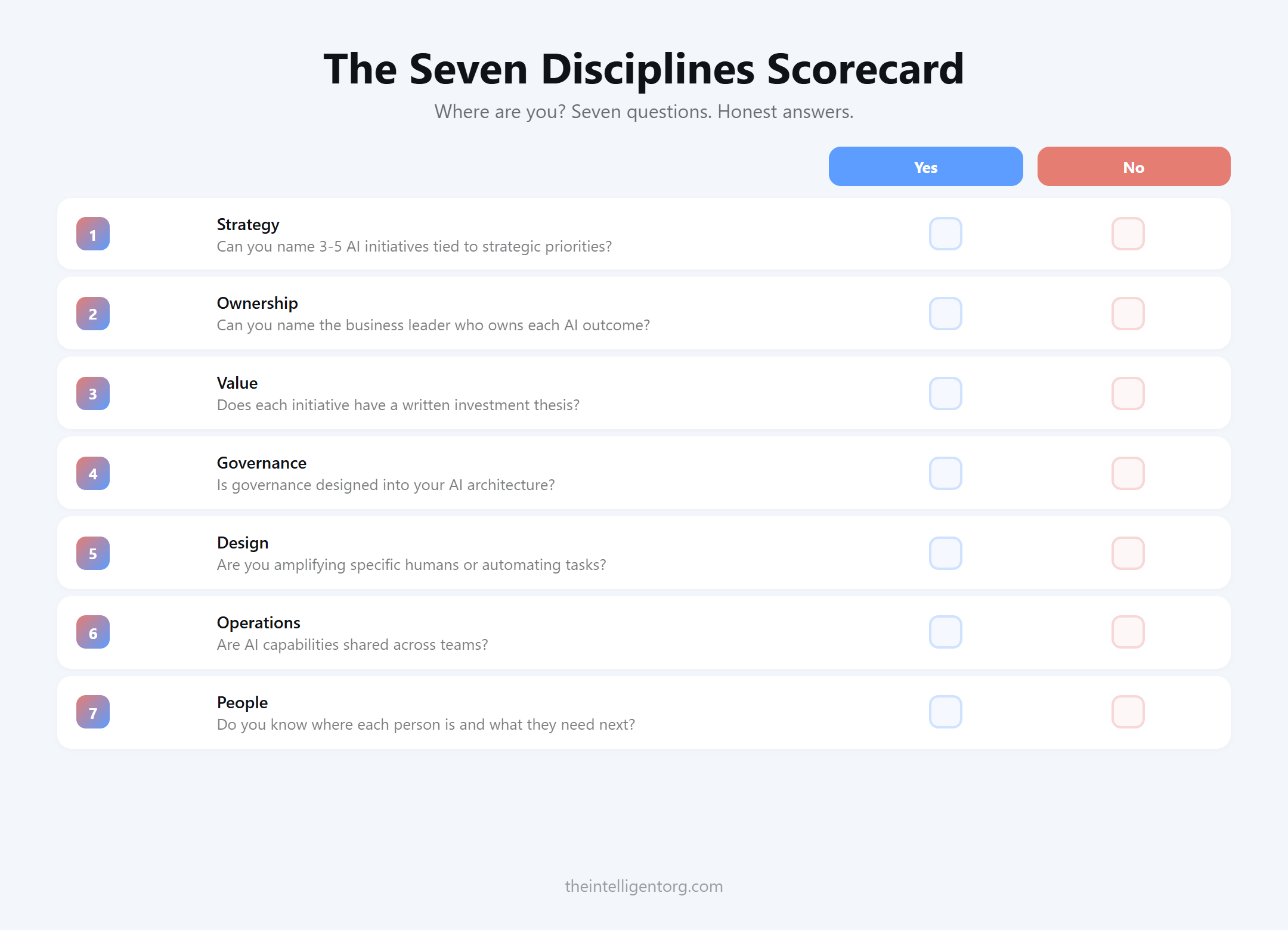

Most executives I talk to answer “yes” to two or three. The ones scaling AI answer “yes” to all seven. They haven’t perfected every discipline. They’re working on the connections between them.
You don’t need equal effort on all seven. You need to know which gaps are breaking the system right now.
The gaps are where to focus next. And I want to know where yours are.
Your answer shapes what we cover next.
What Comes Next
The last seven weeks built the foundation: seven disciplines that every AI transformation needs, working as a system.
Next, we’ll apply them. How to design your first pod. How to think about context and capability engineering. How to connect pods into amplification chains. How to make the build-vs-buy decision. How to spot agent washing before it wastes your budget.
The foundation is set. Now we build on it.
Apply this framework to your company: ChatGPT | Claude | Perplexity
Hannah Mayer et al., “Superagency in the Workplace,” McKinsey & Company, January 2025.
BCG, “From Potential to Profit,” October 2024.
MIT Sloan Management Review, “Expanding AI’s Impact with Organizational Learning,” October 2024.
McKinsey, “The State of AI,” 2024.
Faros AI, “The State of AI in Software Engineering,” 2024.
Julie Bedard and Vinciane Beauchene, “AI Transformation Is a Workforce Transformation,” BCG, February 2026.