

Read time: ~10 minutes
This issue draws from 2025 research by McKinsey, BCG, and MIT’s analysis of 300+ enterprise AI deployments. It’s informed by conversations with executives navigating the same choices, and my own experience leading AI transformation.
The Pattern
5%
That’s the percentage of custom enterprise AI pilots that reach production, according to MIT’s 2025 analysis of 300+ deployments.1 The remaining 95% never ship. They become demos, science projects, and eventually, budget line items that nobody can explain.
5% of enterprise AI pilots reach production. The remaining 95% never ship.
The specific number is debatable. The direction isn’t. Multiple studies confirm that the vast majority of AI pilots never make it to production, and even fewer deliver material business impact.
I can confirm this from my own experience. Over the past year, I’ve reviewed more than 150 AI use cases. The number that reached production? A fraction. The number that delivered measurable impact on the business? Even smaller.
McKinsey’s data tells the same story: More than 80% of organizations see no material contribution to earnings from their generative AI initiatives. Only 1% of executives describe their AI rollouts as “mature.”2
This isn’t a blip. This is the pattern.
A small group of companies are seeing dramatically different results. BCG’s 2025 survey of 1,803 C-suite executives found that leading companies achieve 5x the revenue increases and 3x the cost reductions from AI compared to others.3 Same technology. Same market conditions. Radically different outcomes.
The difference isn’t the AI. It’s the mindset.
Companies that start with “What can AI do?” build demo factories. Companies that begin with “What strategic priority needs solving?” create a competitive advantage.
This is the first of seven shifts that separate companies that win with AI from those that burn resources on pilots that never ship. This shift is foundational. Get it wrong, and nothing else matters.
FOMO vs. Focus
The pattern of failure is remarkably consistent, and it starts with fear.
Boards ask, “What’s our AI strategy?” and teams scramble to show activity. The fear of falling behind drives a flurry of pilots. Every interesting use case gets pursued because saying no feels like missing out.
BCG found that companies struggling with AI spread themselves thin across an average of 6.1 use cases. Leaders, by contrast, focus on just 3.5. That focus translates to 2.1x greater ROI.
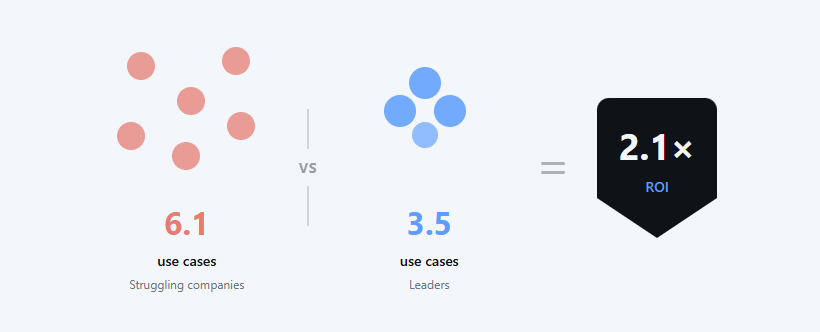
The math is simple but counterintuitive: doing less with AI produces more impact.
A Deloitte survey captured this: “Everyone is asking their organization to adopt AI, even if they don’t know what the output is. There is so much hype that I think companies are expecting it just magically to solve everything.”4 Activity isn’t progress. Pilots aren’t products. Demos aren’t deployments.
Activity isn’t progress. Pilots aren’t products. Demos aren’t deployments.
The result is predictable: resources scatter, nothing reaches production, executives lose faith, and the cycle repeats with the next technology wave.
Why Smart People Keep Making This Mistake
The fundamental error is putting the cart before the horse.
As Harvard Business Review put it in September 2025:
“When companies lead with AI or treat it as the answer, they put the cart before the horse and risk compromising their company’s strategy. But when companies take the opposite approach, starting with strategy, identifying how they can offer buyers a leap in value, and then looking to technology as a tool to deliver that leap, AI can be a powerful catalyst.”5
The technology is genuinely exciting. It’s fun to experiment with. You can suddenly do things that were impossible with traditional automation. The demos are impressive. The possibilities feel endless.
But impressive demos and endless possibilities don’t translate to business impact. They translate to scattered resources and pilot purgatory.
The difference is straightforward:
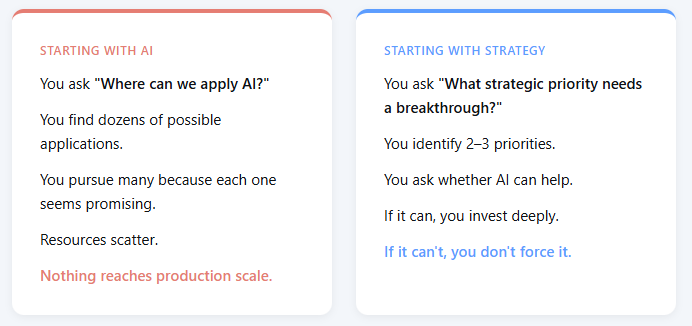
The first approach feels productive. The second approach produces results.
The Incrementalism Symptom
When FOMO drives your AI strategy, there’s a predictable byproduct: incrementalism.
When you’re leading with AI instead of strategy, you’re looking at your existing processes and asking, “Where can I bolt on some automation?” That’s a comfortable question. It doesn’t require rethinking anything fundamental. A chatbot here. An automation there. Minor improvements to existing workflows.
McKinsey’s 2025 research tested 25 attributes to determine what drives AI success. They found that workflow redesign has the most significant impact on an organization’s ability to see the earnings impact of AI. Not the model selection. Not the technology stack. The redesign of how work actually gets done.
Yet only 21% of organizations have fundamentally redesigned workflows as they deploy AI.6
Some executives already understand the difference. Earlier this year, I asked a COO at a mid-size company: What would success in AI look like over the next year? His answer:
“Saving hours and increasing speed on existing processes is great. But if we can completely transform a function, the way they work, with AI, so they are an order of magnitude more efficient or effective. That would be success.”
Transformation is hard. It requires critical thinking about process design, engaging people across functions, and real change management. It’s more complicated than saying, “I can automate this little step.”
But that’s where the value lives.
BCG found that leading companies allocate more than 80% of their AI investments to reshaping key functions and inventing new offerings.7 They’re not looking for 10% efficiency gains. They’re asking: “If we could redesign this function from scratch with AI as a core capability, what would it look like?”
That question requires focus. And focus is the antidote to FOMO.
Focus is the antidote to FOMO.
The Focus Advantage
BCG’s leading companies don’t just focus on fewer use cases. They concentrate their investments in areas that reshape how the business works. They’re selective about where AI can deliver breakthroughs, and they invest deeply in those areas rather than spreading themselves thin across low-impact use cases.
The result: 5x the revenue increases and 3x the cost reductions.8
When you start from strategy and work down to AI applications, you naturally involve senior leadership. The CEO cares about strategic priorities. When you frame AI as a lever for those priorities, it gets executive attention, resources, and cross-functional support.
That’s a setup for success. We’ll dig deeper into the ownership dynamics in next week’s issue, but it starts here, with strategic fit.
What Focus Looks Like in Practice
I learned this lesson firsthand.
When I started leading our AI journey, the approach was bottom-up: “Let’s hear from everybody where they think AI could work. Where in their jobs do they see opportunities for AI agents, use cases, automation?”
What happened was predictable in hindsight. We were flooded with ideas. Hundreds of use cases, most of them low-value. And to keep people engaged, you have to respond. You have to explore each idea at least. Otherwise, you’re ignoring the people you asked to contribute.
We ended up spread thin, exploring many possibilities while making progress on very few.
Then something changed. The CEO identified a strategic imperative: we needed to build an agent because it was mission-critical for achieving a key priority. Suddenly, everything opened up. We had the resources, executive support, and cross-functional engagement. Everything we needed to be successful.
We built a highly capable agent in two months. Our scattered efforts had produced nothing. The difference wasn’t the technology. It was the focus.
The difference wasn’t the technology. It was the focus.
The Framework: Strategy-First AI
How do you move from FOMO to focus? Start with strategy, not with AI.
Here’s a framework that works. It’s inspired by Richard Rumelt’s constraint-based strategy from “The Crux,” adapted for AI decisions.

Step 1: What are your strategic priorities?
This sounds obvious. It isn’t.
If you don’t have clear strategic priorities, don’t start with AI. The technology will not clarify your strategy. It will amplify your confusion.
AI will not clarify your strategy. It will amplify your confusion.
Before any AI initiative, you should be able to point to a specific strategic priority from your existing plan. Not “innovation” or “digital transformation.” A concrete priority: Expand into the small business market. Reduce customer acquisition cost. Accelerate the product development cycle.
If you can’t name the priority, stop. Get clear on strategy first.
Step 2: What makes achieving that priority difficult?
Every strategic priority has constraints. Bottlenecks. Points where progress stalls.
Say your priority is expanding down-market into the small business segment. You’re used to enterprise customers where you invest heavily in proposals, spend significant time one-on-one, and deliver high-touch service. The constraint is scale: How do you serve a higher volume of smaller customers without your cost structure making it unprofitable?
Identify the constraint. The crux. The thing that, if solved, would create a breakthrough on the priority.
Step 3: Can AI materially impact that constraint?
This is where AI enters the conversation. Not before.
Ask three questions about the constraint you’ve identified:
Speed: Can AI dramatically accelerate this? Not 10% faster. Not 50% faster. 10x faster.
Cost: Can AI significantly reduce the operational cost? Not marginal savings. Economics that change the math.
Capability: Can AI enable something previously impossible? New offerings. New markets. New ways of serving customers.
If the answer is yes to any of these, AI might be part of the solution. If the answer is no to all three, AI probably isn’t the right tool for this constraint. And that’s fine. Not every strategic priority needs AI.
This doesn’t mean zero experimentation. It means experimentation in service of a strategic hypothesis, not experimentation as a substitute for strategy.
Step 4: Technical feasibility (last, not first)
Only after you’ve established business viability do you ask about technical feasibility.
Can AI actually do this today? Do we have the data? Is the technology mature enough?
Too many companies start here. They ask, “What can AI do?” and work backward to identify problems. This produces impressive demos that solve problems nobody has.
The sequence matters. Strategy first. Constraints second. AI potential, third. Technical feasibility last.
If the answer is “I don’t know” or “not yet,” that’s okay. Partner with an expert. If it’s not possible today, revisit as the technology evolves. What’s impossible today may be straightforward in six months.
What This Means for You
Self-Assessment
Pull up your list of current AI initiatives. For each one, answer:
Which strategic priority does this serve? (Name the specific priority.)
What constraint does this address? (Name the bottleneck.)
What’s the speed, cost, or capability impact? (Quantify it.)
If you can’t answer these clearly, the initiative probably shouldn’t exist.
The Filter in Action
I’ve watched executives apply this filter and kill most of their AI initiatives. Not because the technology didn’t work. Because the initiatives didn’t connect to the strategy.
That sounds brutal. It’s actually liberating. The resources scattered across a dozen pilots concentrate on two or three that actually matter. The teams that were spread thin get focused on outcomes that executives care about.
The counterintuitive result: fewer AI initiatives, more AI impact.
The Stakes
The companies extracting real value from AI aren’t doing more. They’re doing less, more deliberately. They start with strategy, not AI. They focus investments on a few transformational use cases rather than spreading thin. They redesign workflows end-to-end rather than bolting AI onto existing processes.
Start here, and you’re on your way to the top 5% seeing material impact from AI.
Apply this framework to your company: ChatGPT | Claude | Perplexity
Next week
Shift 2: Ownership & Operating Model
“If you’re planning to delegate the AI revolution, then good luck to you.” That’s Sanofi CEO Paul Hudson. He’s not wrong. McKinsey found that 70% of AI initiatives with business ownership reach production. Only 30% of those handed to IT make it. Same technology. Drastically different outcomes...
BCG, “From Potential to Profit: Closing the AI Impact Gap,” January 2025
BCG, “From Potential to Profit: Closing the AI Impact Gap,” January 2025
BCG, “From Potential to Profit: Closing the AI Impact Gap,” January 2025