

Read time: ~10 minutes
This issue draws from systems thinking research by W. Edwards Deming, Donella Meadows, and Peter Senge. It’s informed by conversations with executives making the same choices, and my own experience leading AI transformation.
The productivity paradox
Your best people are crushing it with AI. Your organization isn’t getting better.
Faros AI analyzed 10,000+ developers across 1,255 teams. Individual AI users complete 21% more tasks and merge 98% more pull requests.1 The productivity gains are real and measurable at the individual level.
At the company level, there is no correlation between AI adoption and better outcomes. Pull request review times increased 91% as human approval became the bottleneck. Bug rates climbed 9% per developer. Throughput stays flat. Quality doesn’t move. The organizational impact never arrives.
You have the hero. You don’t have the system.
This pattern repeats across industries. One person discovers AI and triples their output. They move faster, handle more complexity, and deliver better results.
Everyone else waits for them.
Work flows to the hero because nobody else knows how to do it. The hero’s workflows are personal. Their outputs work for them, but break when someone else tries to use them. Their knowledge stays locked in their head. The capability never spreads.
You can’t scale the hero. You can only wear them out.
You can’t scale the hero. You can only wear them out.
The problem isn’t the people. It’s the system around them.
“A bad system will beat a good person every time. Complex systems have many leverage points and can be influenced in many ways. It is unreasonable to have a broken management system and blame those working within it for the naturally poor results than such a system creates.”
W. Edwards Deming2
The shift: systems, not heroes
Individual amplification is where it starts. Systems are how it scales.
In Issue 5, we introduced the pod: a human plus AI plus capabilities, owning a defined scope of work. That’s individual amplification. But pods don’t operate in isolation. They connect into amplification chains, and chains execute your value chain. That’s the system. Issue 5 was about designing the pod. This issue is about what happens between them.
You don’t scale AI just by amplifying more individuals. You scale AI by redesigning the system in which those individuals operate.
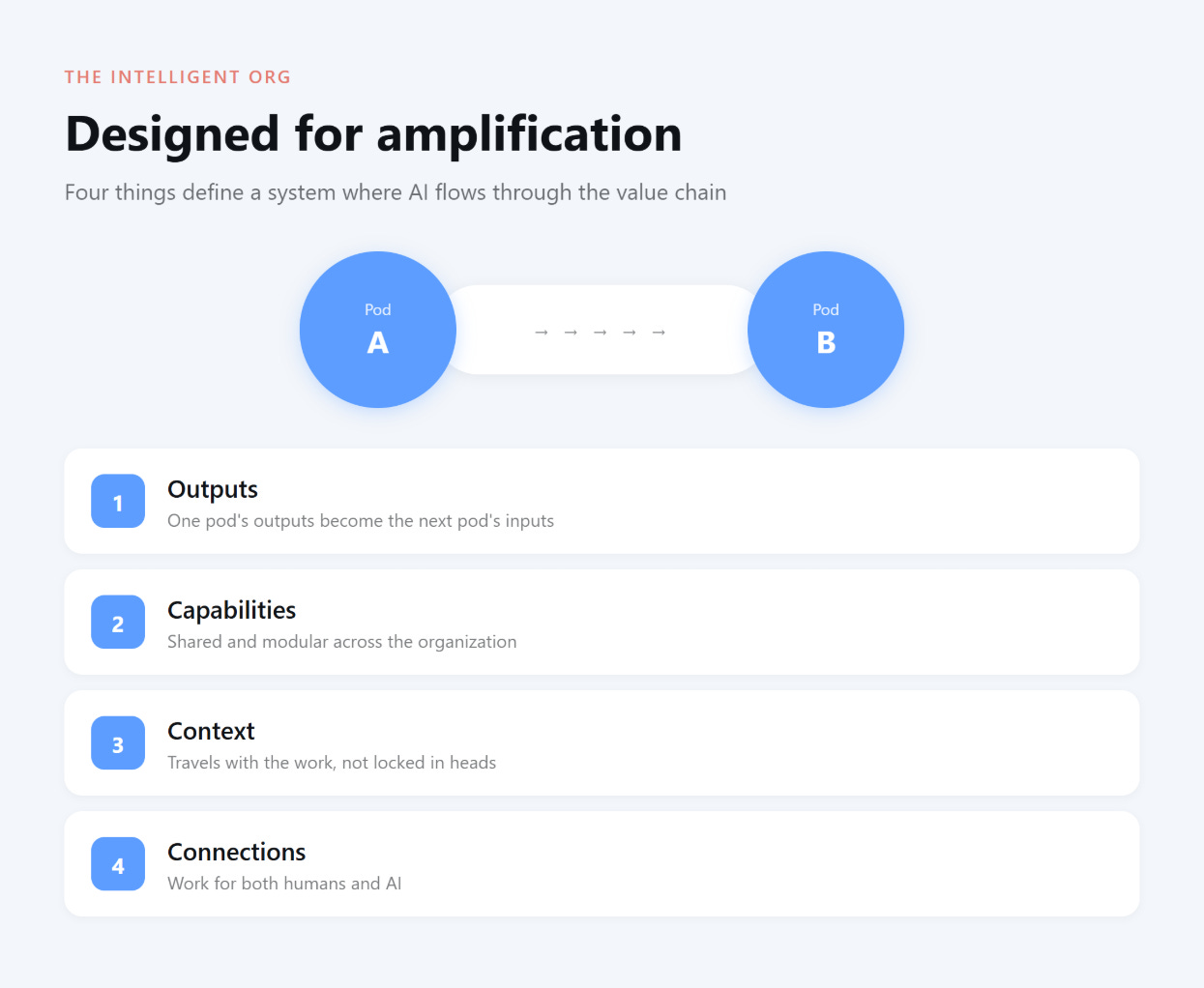
The system is not a process map. It’s not an SOP. Four things define a system designed for amplification:
Outputs: How outputs from one pod become inputs for the next
Capabilities: How capabilities are shared and modularized across the organization
Context: How context travels with the work
Connections: How the connections between pods work for both humans and AI
Get these four right, and the system works. Miss any of them, and the value stays trapped.
When you design the system for amplification, extraordinary individual performance becomes organizational capability.
When the system fights amplification, heroes burn out, and nothing scales.
Why scaling is so hard
The concept is simple. The execution is brutally difficult.
Operations is the hardest discipline in AI transformation. The data confirms it.
Despite widespread AI adoption (88% of organizations use AI in at least one function), 67% remain stuck in the pilot or experimentation phase.3 Only 39% report any EBIT impact at all. MIT found that 95% of enterprise AI pilots produce zero measurable returns.4 Only 5% of companies achieve AI value at scale.5
Only 5% of companies achieve AI value at scale.
The ones that succeed aren’t smarter. They’re doing something different about the system.
Your tools weren’t built for this
Your entire operational stack was built for humans clicking through GUIs (graphic user interfaces). PSA systems, CRM platforms, ERP databases, project management tools, PowerPoint decks, Word documents. Data sits trapped in proprietary databases, rendered through web interfaces, locked in file formats that only humans can read.
The MSP runs on a PSA system. An L1 tech closes a ticket with “fixed it.” The resolution data exists only as free text in a field designed for human reading. Next time the same issue occurs, the system treats it as brand new. Someone created the knowledge, but it never became a shared capability.
The professional services firm uses a CRM. Deal closes, project kicks off. Everything the salesperson learned about client needs, pain points, and relationships stays locked in their head or buried in email threads. The delivery team starts from scratch. No connection between sales and delivery exists. Everything that made the sale successful is lost.
The marketing agency lives in Google Docs, Slack, and nested folders. Creative brief in one Doc. Feedback scattered across threads. Final assets in a folder somewhere. Campaign results in a hand-built deck. Every transition requires a human to reassemble context from scratch.
Getting AI to flow through these systems isn’t a configuration change. It’s rethinking how work moves and what format it takes.
Research on organizational workflows confirms what executives already know:
“A common class of problems with information transfer and handoffs includes degradation of information. If methods of transfer are informal and not documented, information may not be passed on when staff members leave. The lines of responsibility and expectations are not always clear.”6
Each connection loses context. Each transition requires rebuilding understanding. Individual AI wins don’t carry over because no one designed the system to carry them forward.
The human side compounds everything. People in your organization sit at different levels of AI capability. Some use chatbots for drafts. Others direct agents that take real action. Your system has to work across all of them, and your pods will reflect that unevenness. This is an identity-level change, not a skills gap. We’ll cover it fully in the next issue.
You can’t stop the business to redesign it
Alerts keep firing. Clients keep calling. Deadlines keep arriving.
You need to rebuild the plane while flying it. Big-bang transformation fails because the business can’t pause. Inaction means you fall further behind while competitors figure it out.
The gap is widening. Companies that scale AI achieve 3 percentage points more EBIT (a 30% lift compared to those that don’t), with revenue impact tripling from 6% to 20% or more.7 Future-built companies show 1.7x revenue growth, 3.6x three-year shareholder returns, and 1.6x EBIT margin versus laggards.8
The ones that don’t scale are paying the cost in competitive position.
You can’t stop. You can’t wait. You have to change the system while it’s running.
The payoff is real but delayed
When you amplify one person, the ROI is obvious. They produce more, faster, better. You can point to it.
When you redesign a connection between pods, the payoff is harder to see. You restructure how sales connects to delivery. Six months later, the delivery ramp-up time drops 40%. Rework decreases. Client satisfaction scores move. But no single metric captures the full impact because the value spreads across every deal that flows through the redesigned connection.
This lack of clear ROI is why most organizations underinvest in systems work. The metrics they track (Issue 3) are built for individual performance, not systemic improvement. You need leading indicators for systemic change: connection quality, context retention, and capability reuse. Most organizations don’t measure these, so the investment looks like cost with no return.
How to start
No proven playbook exists for this. The companies that succeed are figuring it out as they go. But the principles are clear.
See the system
Stop looking at the org chart. Start looking at your value chain.
Not the process map. Not how it’s supposed to work. Rather, how work moves in practice.
Where are the pods? The places where one amplified human could own a complete portion of work.
Where are the connections between pods? The points where one pod’s output becomes the next pod’s input.
Where are the broken connections? The points that lose context, cause rework, or pull in the hero.
This is systems thinking applied to your value chain. You’re not looking at individuals. You’re looking at what happens between them.
Identify the hero reinforcing loops:
Hero solves everything → nobody else learns → more gets escalated to hero → hero becomes more indispensable → nobody else learns.
This is a system trap, not a people problem. You can’t fix it by hiring another hero. You fix it by redesigning the system so the hero’s knowledge becomes a shared capability.
This isn’t a months-long process mapping exercise. It’s seeing your value chain with new eyes.
Find the highest-leverage connection
Not all connections between pods are equally broken. Not all redesigns produce equal returns.
Systems thinker Donella Meadows spent her career studying where to intervene in complex systems. Her insight: most organizations spend 95-99% of their attention on parameters (changing numbers, tweaking details, adjusting process steps). Parameters are the lowest-leverage intervention.9
The highest-leverage points are changing information flows, changing the rules of the system, and changing goals. Yet almost nobody works at these levels.
Apply this to your value chain. Ask four questions about each connection:
Which connection loses the most context?
Which one causes the most rework?
Which one pulls in the hero most often?
Which one, if fixed, would create a capability useful to most other pods?
That’s your starting point. One connection. Not the whole value chain. Not the whole business. One pod-to-pod link.
What leverage looks like in practice:
Take the professional services firm. Sales closes a deal. Delivery needs to ramp up.
Low leverage: Requiring salespeople to fill out a handoff form before delivery starts. It’s a parameter change. Most will skip it or do it poorly. The connection doesn’t improve.
Medium leverage: Restructuring how discovery information flows. Every discovery call produces a structured document that delivery can consume. The information now travels with the work.
High leverage: Making the discovery process itself a shared capability. Both sales and delivery pods contribute to and build on the same client knowledge base. The connection becomes a two-way flow that improves with every deal.
Most organizations are stuck at low leverage. The high-leverage intervention creates a shared capability that compounds.
Pick the connection where fixing it creates a capability that can be reused. That’s high leverage.
As Meadows put it: “Missing feedback is one of the most common causes of system malfunction. Adding or restoring information can be a powerful intervention, usually much easier and cheaper than rebuilding physical infrastructure.”10
Let it compound
Each redesigned connection creates something reusable. A shared capability. Each shared capability makes the next connection easier to fix and the next pod easier to build.
This is the positive reinforcing loop. The opposite of the hero trap.
One connection redesigned → shared capability created → next connection easier to fix → more capabilities shared → system accelerates.
You don’t need to redesign the entire value chain upfront. You need to start the compounding loop.
Design principles for each redesigned connection:
Outputs consumable by both humans and AI
Not readable by humans alone. Structured so the next pod’s AI can process them too.
I’m building this right now. A strategic intelligence system I’m designing produces all outputs in two formats: Word documents for humans who read them and Markdown in a vector database for agents that consume them. Same information, structured for two audiences. An executive reads the competitive brief and gets a polished document. Another pod’s AI needs that intelligence to inform a proposal or a pricing decision and pulls from the Markdown database.
Your consumers are no longer just humans.
Your consumers are no longer just humans. You’re designing for connections between pods, and the next pod might be running on AI. The MSP that writes “fixed it” in a text field is designing for humans only. Structured data (problem type, solution applied, knowledge base article referenced) serves both. Humans can read it. AI can learn from it. The next time the issue occurs, the capability exists.
Context travels with the work
Not in meetings, Slack threads, or people’s heads. Structured and attached to the work itself.
Example: The professional services firm. Instead of tribal knowledge in the salesperson’s head, a structured discovery document (generated from call transcripts and notes) that moves with the deal. Client pain points, success criteria, decision makers, constraints. The delivery pod starts with the same context as the deal-closing conversation.
Capabilities shared, not siloed
When one pod builds something valuable, expose it to other pods. Don’t rebuild the same capability everywhere. Modular by design.
Example: One pod builds an integration to extract data from your PSA. Instead of building it once for one use case, expose it as a shared capability. Other pods access the same data without rebuilding the integration. This is what technical teams should build: capabilities that amplify multiple pods, not point solutions for individual tasks.
Where are you now?
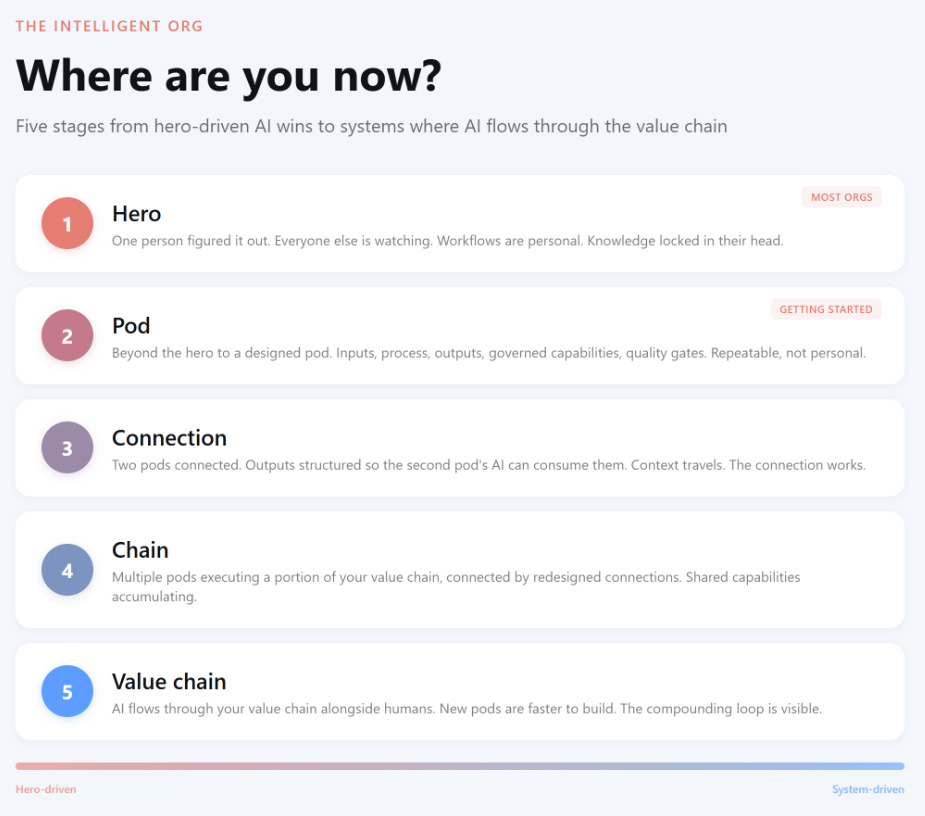
Most organizations are at one of five stages:
Stage 1: Single hero succeeding with AI
One person figured it out. Everyone else is watching or waiting. The hero’s workflows are personal. Knowledge is locked in their head. No pods.
Stage 2: First amplified pod designed and operating
You’ve moved beyond the hero to a designed pod. Inputs, process, outputs, governed capabilities, and quality gates. It’s repeatable, not personal.
Stage 3: First connection redesigned for humans + AI
You’ve connected two pods. The outputs from the first are structured so the second pod’s AI can consume them. Context travels. The connection works.
Stage 4: First amplification chain running
Multiple pods executing a portion of your value chain, connected by redesigned connections. Shared capabilities are starting to accumulate.
Stage 5: Multiple chains executing the value chain
The system is running. AI flows through your value chain alongside humans. New pods are faster to build because they share capabilities. The compounding loop is visible.
Most readers are at stage 1 or 2. That’s fine. The value is knowing what’s next.
The choice
Nobody has this fully figured out. This is the frontier.
The companies that will scale aren’t waiting for the perfect playbook. They’re picking one connection between pods, redesigning it, learning from it, and expanding.
The 42% of companies that scrapped most AI initiatives in 2025 (up sharply from 17% the year before) are the ones that tried to solve the whole system at once, or the ones that amplified heroes without redesigning the system around them.11
The 5% that scale are doing something different.12 They’re thinking in systems. They’re finding leverage points. They’re letting it compound.
High performers are three times more likely to redesign workflows fundamentally.13 McKinsey tested 25 organizational attributes to identify what drives AI value. Workflow redesign emerged as the factor with the strongest contribution to EBIT impact.14
Yet only 21% of organizations have redesigned workflows.
Yet only 21% of organizations have redesigned workflows.
That gap is the opportunity.
Systems, not heroes. One connection at a time.
Apply this framework to your company: ChatGPT | Claude | Perplexity
Next week
Next issue: Systems need humans who can work within them. How do you prepare your people for amplified work? How do you hire for it? Discipline 7: People.
Faros AI, “The AI Productivity Paradox Research Report,” July 23, 2025.
Deming Institute, “The Transformation is Everybody’s Job,” April 17, 2017.
Alex Singla, Alexander Sukharevsky, Bryce Hall, Lareina Yee, and Michael Chui, “The State of AI in 2025: Agents, Innovation, and Transformation,” McKinsey Global Survey, November 5, 2025.
Aditya Challapally, Chris Pease, Ramesh Raskar, and Pradyumna Chari, “The GenAI Divide: State of AI in Business 2025,” MIT Media Lab / Project NANDA, August 2025.
Boston Consulting Group, “The Widening AI Value Gap: Build for the Future 2025,” September 2025.
Carol Cain and Saira Haque, “Organizational Workflow and Its Impact on Work Quality,” Patient Safety and Quality: An Evidence-Based Handbook for Nurses, Agency for Healthcare Research and Quality (US), April 2008.
Vladimir Lukic, Karalee Close, Michael Grebe, Romain de Laubier, Marc Roman Franke, Michael Leyh, Tauseef Charanya, and Clemens Nopp, “Scaling AI Pays Off, No Matter the Investment,” Boston Consulting Group, January 10, 2023.
Boston Consulting Group, “The Widening AI Value Gap: Build for the Future 2025,” September 2025.
Donella Meadows, “Leverage Points: Places to Intervene in a System,” The Donella Meadows Project, 1997.
Donella Meadows, “Leverage Points: Places to Intervene in a System,” The Donella Meadows Project, 1997.
S&P Global Market Intelligence, “Generative AI Shows Rapid Growth but Yields Mixed Results,” October 2025.
Boston Consulting Group, “The Widening AI Value Gap: Build for the Future 2025,” September 2025.
Alex Singla, Alexander Sukharevsky, Bryce Hall, Lareina Yee, and Michael Chui, “The State of AI in 2025: Agents, Innovation, and Transformation,” McKinsey Global Survey, November 5, 2025.
Alex Singla, Alexander Sukharevsky, Lareina Yee, Michael Chui, and Bryce Hall, “The State of AI: How Organizations Are Rewiring to Capture Value,” McKinsey Global Survey, March 2025.