

Read time: ~8 minutes
This issue draws from 2024-2025 research by BCG, Gartner, and McKinsey. It’s informed by conversations with executives navigating the same choices, and my own experience leading AI transformation.
We Built the Agent. We Weren’t Capturing the Value.
Last year, my team built an agent to save our account managers’ time. Ten hours per month each, freed from low-value tasks.
We could track the savings.
Halfway through, we realized we couldn’t answer: “Show me on the P&L where that value is.”
We’d created value. We had no plan to capture it.
The Evaporation Problem
This isn’t just my mistake. Across companies, AI value is evaporating.
Gartner found that teams deploying AI save five hours per person per week.1 That sounds like a win. But most of that time disappears into low-value tasks. The hours are freed. But the value never reaches the P&L.
It dissipates into scattered minutes, absorbed by whatever work expands to fill the space. Nobody planned where that time would go, so it went nowhere.
The pattern is everywhere: 88% of organizations use AI regularly, but only 39% report any EBIT impact.2 Only 4% consistently capture value.3
While 88% of organizations use AI regularly, only 4% are consistently capturing value.
You can spot who’s going to become one of these statistics. They write the investment thesis after development starts. They estimate time savings with no plan to change behavior. They build ROI decks only at budget renewal time. Finance has never touched the measurement.
Why does this happen?
Three reasons. All connected.
Disconnected from strategy. When AI initiatives aren’t aligned to strategic priorities, you end up inventing metrics to prove value. Custom dashboards. Novel KPIs. Reports leadership doesn’t watch. Align AI to what the company already cares about, and measurement is built in. This is Shift 1.
The wrong owners. When IT or a centralized AI team owns AI initiatives, they’re measured on delivery, not business impact. They ship the agent. They show it works. But they’re not accountable for whether the business captures value from it. That’s the handoff trap from Shift 2. Without business leaders owning AI outcomes, nobody redesigns the work.
Redesign is where value lives. “It can be hard to turn small time savings into meaningful cost savings,” McKinsey explains. “Today’s gen AI systems automate parts of roles, rather than whole jobs, making it difficult for companies to redeploy people freed up by automation.”4
How do you redeploy people from scattered minutes? You don’t. Unless you redesign the work itself.
Savings Don’t Capture Themselves
Every AI initiative needs two plans: one for creating value, one for capturing it. We had the first. We skipped the second.
We should have partnered with sales leadership and revenue operations before we built anything. The first question: What are the strategic priorities for account managers?
If the priority is coverage (maximize accounts per rep), then a 7% time savings becomes a 7% increase in accounts per rep. That’s capture. The model changes.
If the priority is depth (maximize high-touch communication), then revenue enablement coaches account managers on how to use their freed-up time strategically. That’s capture. The behavior changes.
Either way, the CFO can point to it. Revenue per account manager. Accounts per rep. Something real on the P&L.
We saved ten hours a month. We changed nothing about how those hours got used. The savings evaporated because we never decided how to capture them.
What are the 4% doing instead?
Compare my account manager story with Klarna. Same starting point: time savings. Different outcome: $60 million.
The difference wasn’t the technology. It was the capture mechanism, defined before they built anything.
Klarna: Time savings → Headcount5
Klarna’s CEO publicly committed to specific savings targets tied to their IPO. The investment thesis came first. The value driver: time savings in customer service. The capture mechanism: reduced hiring.
Not “we saved X hours.” Instead: “We won’t hire the 700 people we would have needed.” Their AI now handles two-thirds of customer service. Resolution time dropped from 11 minutes to 2 minutes. $60 million in savings, because they decided upfront how value would hit the P&L.
Dow Chemical: Error reduction → Invoice savings6
Their Chief Digital Officer stated upfront: “Even a 1% improvement would mean substantial savings” on billions in shipping spend. That’s an investment thesis. Bounded problem, clear metric.
The value driver: quality (error detection). The capture mechanism: invoice corrections tied to known shipping spend. Their AI analyzes 43,000 shipments and finds anomalies in minutes that used to take weeks. Millions in freight savings, because they knew exactly where it would show up.
DBS Bank: Strategic value → Three defined streams7
DBS developed a value capture framework with McKinsey before scaling. They refused to hide behind “strategic value.” Instead, they defined three streams: revenue, cost savings, and risk avoidance.
$576 million captured in 2024. $768 million projected for 2025. 1,500 AI models in production. They became the first bank to show investors: higher revenue, lower cost-to-serve, and higher ROE from digital customers. Strategic value stopped being a shield. It became a measurable category.
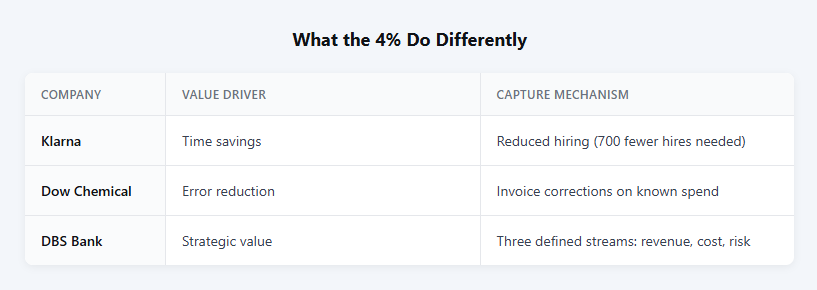
The pattern: Everyone defined the capture mechanism before building. We never defined ours at all.
Operational vs Strategic
Operational value hits the P&L in 3-12 months. Klarna’s $60 million. Dow’s freight savings.
Strategic value builds capability or position over 12-36 months. It may never show up directly.
“This initiative is strategic,” is doing a lot of work in most organizations. Sometimes it’s real. Sometimes it’s a pet project with a nice label.
Pet projects often hide behind the claim, “This initiative is strategic.”
Here’s how to tell the difference.
Consider a competitive intelligence agent that helps executives make better decisions. Clearly valuable. But try pointing to a line on the P&L.
You could claim a similar system costs $80K/year off the shelf. But that’s a proxy, not a capture mechanism. It won’t show up on the P&L unless you’re actually displacing that $80K system.
So the move with strategic value is to ask, “So what?” Repeatedly.
We want better market and competitive intelligence.
So what?
So our executives can make better strategic decisions.
So what?
So we can increase our revenue per employee.
How will you know if this initiative is successful?
Revenue per employee has too many variables to use as a proxy. Better market intelligence is too subjective. Better strategic decisions can work as a proxy if we document our decisions and track the success rate over time.
That’s the test for real strategic value: can you document what it actually is and how you’ll know if it’s working?
If you can’t answer both, it’s not strategic value. It’s a pet project with a nice label.
Five Questions Before You Build
So how do you make sure you’re building something real?
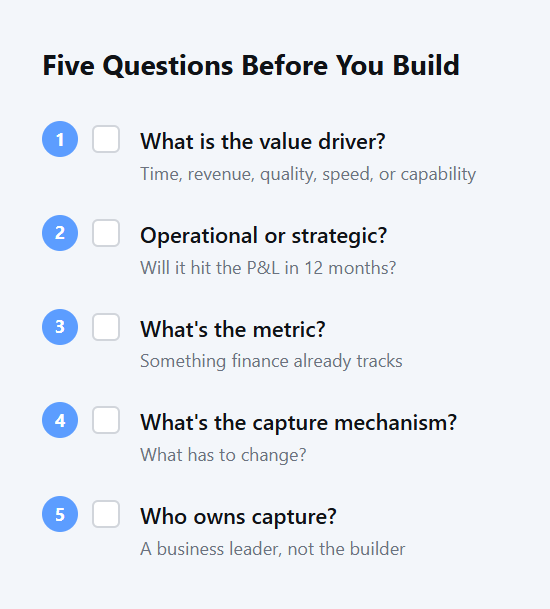
Klarna, Dow, and DBS all started the same way: with an investment thesis. Not a slide deck. A clear answer to five questions:
What is the value driver? Time, revenue, quality, speed, or capability.
Operational or strategic? Will it show up on the P&L in 12 months?
What’s the metric? Something finance already tracks, or a proxy you’ve defined upfront.
What’s the capture mechanism? What has to change for the value to be realized?
Who owns capture? A business leader, not the builder.
If you can’t answer these five before you build, you’re not ready to build.
This isn’t about adding process. It’s about having the right conversation before you start, rather than constructing a story after.
What to do next
Pick your most important AI initiative. Answer the five questions.
If you’re writing the investment thesis now, after you’ve already started building, that’s okay. Most companies are. But now you know what’s missing for next time.
If you can’t answer all five, pause. Have the conversation before building further. Bring the gaps to your next leadership meeting.
What changes when you do this consistently? You stop constructing stories after the fact. You design for capture from day one. When the CFO asks, “Show me on the P&L,” you can.
Apply this framework to your company: ChatGPT | Claude | Perplexity
The companies that capture value from AI and those that don’t aren’t running different technology.
The difference: they answer the five questions before they build. They define the capture mechanism. They assign a business leader to own it.
Don’t settle for creating potential value. Capture value.
Next Week
Next issue: Once you’ve defined how value gets captured, you need to manage the risks of getting there. Shift 4: Risk & Governance.
Gartner, “Forget Layoffs: AI Is Coming for Inefficiency, Not People,” December 2025
McKinsey, “The State of AI in 2025,” November 2025
BCG, “Where’s the Value in AI,” October 2024
McKinsey, “The State of AI in 2025,” November 2025
Klarna: “Klarna says its AI agent is doing the work of 853 employees,” CX Dive, November 2025
Dow Chemical: “AI impact at Dow: Copilot identifies millions in cost savings,” Microsoft WorkLab, November 2024
DBS Bank: “DBS CEO Tan Su Shan on building a gen AI–enabled bank with a heart,” McKinsey, September 2025