

Read time: ~10 minutes
This issue draws from 2024-2025 research by McKinsey, BCG, and RAND. It’s informed by conversations with executives navigating the same choices, and my own experience leading AI transformation.
The Pattern
If you’re planning to delegate the AI revolution, then good luck to you. - Paul Hudson, CEO of Sanofi.1
The board asks about what you’re doing with AI. The CEO nods. “We’re on it.” Then, in the next leadership meeting: “AI is important. CIO, go figure it out.”
Fast forward, you’re trying to diagnose what went wrong. Why none of your impressive AI pilots make it to production. Why AI isn’t moving the P&L.
If this rings true, you’re in the majority. That’s the problem.
When a new technology emerges, the default is to defer to the CIO so the CEO can stay focused on the business. Here’s the problem: agentic AI is a revolution in how work gets done, disguised as an IT project.
Agentic AI is a revolution in how work gets done, disguised as an IT project.
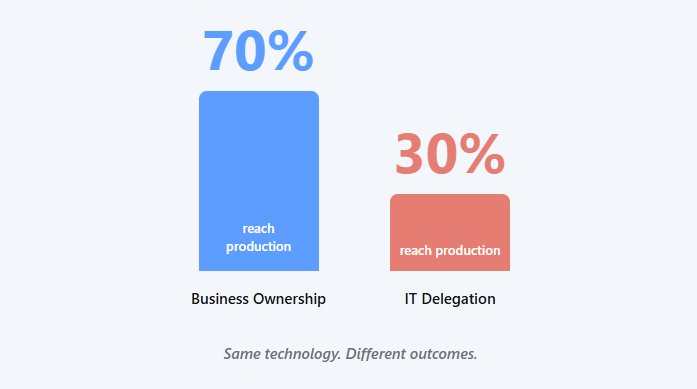
McKinsey found that 70% of AI initiatives with centralized business ownership reach production.2 Only 30% of those delegated to decentralized IT teams make it. Same technology. Drastically different outcomes. This is the handoff trap. And most companies are stuck in it.
When I spoke with a president at a mid-size professional services firm, this pattern was unmistakable. I asked who at his company owned AI outcomes; the IT director was responsible.
Was this a strategic decision? “Not really a lot of strategic thought or collaboration around what is the best way for us to tackle this. It was more just based on how decisions are made in the company.”
AI is technology, IT handles technology, so IT got it by default.
This led to two separate proposal generation pilots over two years. The first “died on the vine within months” because the assigned leader “doesn’t really have the juice to make it happen.” The second started at the beginning of 2025 and still isn’t finished. “Honestly, we’re still not done with the pilot. I’ve been shocked at how long it’s taken.”
What Delegation Produces
“If you delegate, here’s how it goes... ‘We delegated it to our CDO. We can build it ourselves.’ And then they hope that you will forget you ever asked. It’s corporate lingo, shorthand for ‘We have no idea.’” - Hudson
Who “owns” AI in your business? Who decides which functions to prioritize? Who decides which cross-functional processes, like lead-to-order, get automated? Who says no to low-value use cases?
If the answer is “I’m not sure” or “we have a committee,” you’ll get activity. But what shipped? What changed?
Teams choose use cases because they rock the boat the least, leading to bolt-on automations that work in isolation but deliver little value. Or they get selected for technical interest rather than business impact. Pilots never leave the lab, and you end up with innovation theater.
All of this points to gaps in leadership, not technical know-how.
Nearly all leading companies have engaged C-suites leading AI transformation, while only 8% of laggards do, according to BCG. 3
Only 8% of laggards have engaged C-suites leading AI transformation.
This is one of the simplest solutions to the pervasive lack of AI ROI: Engage. Dig in. Don’t abdicate your responsibility as CEO, COO, or business leader.
The Delegation Reflex
For too long, non-technical executives have happily deferred tech to the technical folks. You may even take pride in focusing on your area of expertise while letting the tech team do their thing.
The very fact that we call technology-related projects “IT projects” shows how prevalent this mindset is. It’s IT’s job, not mine.
This mentality comes from fear. Fear of being found out as a fraud. Fear that if you don’t know the technology, you’re going to lose your authority.
We’ve been taught to delegate. In my executive MBA program, the approach was straightforward: learn broadly so you can delegate well and ask the right questions. This approach works in well-defined disciplines like finance and marketing.
Delegation works for most things. But AI breaks this pattern.
It doesn’t work because agentic AI is a revolution in how work gets done disguised as an IT project. To get ROI from your AI investments, you must reimagine and redesign your work end to end. It is the competency most correlated with AI ROI according to McKinsey.4
Your Director of IT cannot decide that the sales team needs to change how they sell. The CIO cannot tell operations to change how they handle the supply chain. The CDO cannot tell the head of finance that they need to change their book-closing process.
These are business decisions. Your CIO can’t make them. Your CDO can’t make them. If you own the outcome, you own the decision.
As the professional services firm president put it: “You need to look at what the business is, what the business does, make sure whatever you’re doing is supporting that and not the cart driving the horse.”
RAND found that 84% of AI initiative failures trace back to leadership problems, not technology problems.5 The failures follow the same pattern:
Business leaders can’t articulate what they actually need (because they don’t understand AI’s capabilities)
Technical staff optimize for the wrong outcomes (because they don’t understand the business context)
Miscommunication compounds until the project solves the wrong problem
The result: pilot purgatory.
BCG recommends a different way with their 10-20-70 model. 10% of the focus on data and models. 20% of the focus on the technical infrastructure and tools. The remaining 70% of the focus on the people and processes.
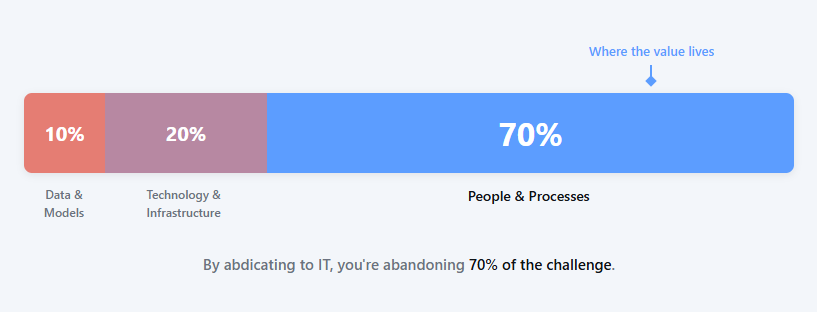
By abdicating to IT, you’re abandoning 70% of the challenge. As BCG puts it, “exclusive IT ownership is a key indicator of stagnating companies.”6
Delegation vs. Ownership
Paul Hudson, the CEO I quoted at the start of this issue, decided to lead Sanofi's AI transformation personally. He chose not to delegate to his CDO, even though “CEOs of his generation delegate.”
As Gilmurray (CEO of KG & Co) says: “To scale successfully, AI needs the same rigor as any other strategic initiative: a clear vision, a business owner who’s accountable for results (ideally an executive), high-quality data and the right success metrics.”7
Hudson decided that, rather than delegating AI to IT and letting them automate a few low-value use cases, Sanofi would transform the value chain end to end.
“I think our competitive advantage will be that we go all in, end-to-end, while others are dabbling, doing proof of concepts, handing the project off to CDOs, rather than understanding its relevance.”
The result: Sanofi was able to look at processes from the customer value point of view, rather than internal siloed processes: “We look at everything end-to-end. Can we go cheaper? Can we go more robust in certain areas? Can we introduce a shop floor agent to improve asset utilization? Can an agent help with drug design and discovery?”
The outcomes?
“Using AI, we reduced out-of-stocks by 80 percent, which is close to a billion euros, and we improved asset utilization by more than ten percentage points.”
Note what Hudson doesn’t do: he doesn’t build agents, attend daily standups, or manage technical teams. He decides what matters and removes roadblocks. That’s ownership. Everything else is delegation done right.
At a €43B company, that means an annual review. At your company, it means more: quarterly reviews, monthly visibility, and direct involvement in prioritization decisions. Your company is smaller than Sanofi. Your involvement needs to be greater. The principle doesn’t change.
The opposite? BCG’s laggard profile (notice the compounding effects of these policies):8
Spend less on IT
Spend less of their IT budget on AI
C-suite not deeply engaged on AI
Less likely to have shared business-IT ownership on AI
By saying yes to the delegation reflex, Paul would have been in the majority of CEOs today. He would have passed on the opportunity for end-to-end transformation, and Sanofi would be dabbling like most companies, struggling to see real impact from AI.
How to Make the Shift
This shift is uncomfortable. The CEOs who step up and lead their companies through the AI revolution will be the leaders of the great companies in the next decade. That requires humility: asking questions, admitting gaps, and learning.
Embrace the 10-20-70 model. 30% of the effort goes to building the technology. 70% goes to change management: redesigning work, measuring ROI, and getting leadership support for AI initiatives.
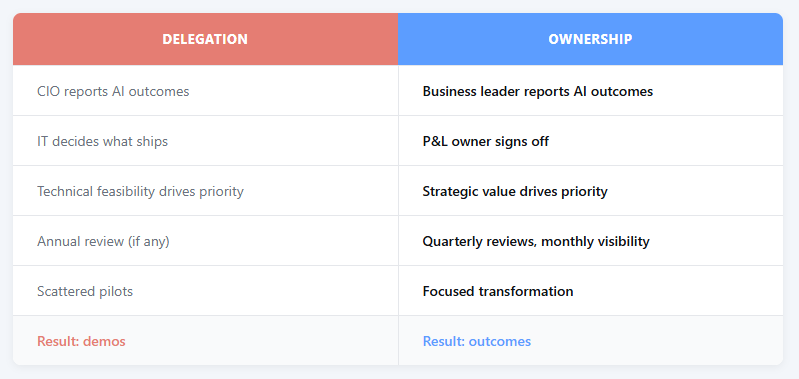
The rule: the P&L owner signs off on every use case. AI initiatives don’t move forward without the business leader being accountable for the outcome.
AI initiatives don’t move forward without the business leader being accountable for the outcome.
Next, the CEO must own AI outcomes. The CEO should “chair” the weekly, monthly, quarterly AI review. Ask these questions:
Which initiatives delivered measurable value this quarter?
Which should be killed?
What’s blocking the ones that matter?
Follow Hudson’s example: “I ask the key questions. I want to see the innovation, and I want to know how it’s happening in the most critical areas of the company.”
Finally, flip accountability onto the business leaders. Hudson: “I set a challenge for my leaders: Disrupt your function with agentic AI by the end of the year. AI is the one thing that drives disruption.”
Business leaders report on AI outcomes (revenue, cost, speed, quality). IT reports on enablement (infrastructure performance, guardrails adherence, evaluations). This is NOT a CIO demotion. It is role clarity. Your CIO might be the most business-savvy person in the room. The issue isn’t their capability. It’s that AI transformation requires decisions only business line owners can make: which processes to redesign, which functions to prioritize, which sacred cows to kill.
AI transformation requires decisions only P&L owners can make.
This is what ownership looks like in practice. As the president of the professional services firm put it, “What I would want to do is take it back into operations... Let’s brainstorm and identify the things that give the biggest bang for the buck to the business. We may need to carve out one person’s time completely for a year to lead this. A very strategic person to move things forward.”
The CEO sets the pattern. Delegate to IT, and so will everyone else.
The Ownership Test
When AI comes up at the board meeting, who presents?
CIO presenting outcomes → you’ve delegated
Business leader presenting outcomes, CIO presenting enablement → you own it
If you’re unsure, ask three questions:
Who’s accountable for AI outcomes? (Name a person, not a committee.)
Who decides which initiatives go forward? (Technical feasibility or strategic value?)
What does IT report on? (Outcomes or enablement?)
The Conversation to Have This Week
In your next C-suite meeting, ask one question: “Who is accountable for AI outcomes in this company?”
Not IT. Not middle management. A C-level leader who is business-oriented and can report to the board.
What you’re listening for:
Silence or confusion → ownership is undefined (common, fixable)
“IT” → you’ve delegated (recognize the pattern)
“I am” (from CEO/COO/business leader) → you own it (verify with practices)
This isn’t about blame. The instinct to delegate is understandable. The fix is structural: assign a business owner, establish the operating rhythm, let IT enable.
So What
IT enables. Business owns. That’s the shift.
More than 80% of AI projects fail, according to RAND.9 And 84% of those failures trace to leadership, not technology. The handoff trap is structural: delegate to IT, get demos. Own at the C-level, get outcomes.
Hudson’s closing thought:
“CEOs should not underestimate the personal energy required. As people have said, AI may be the greatest revolution since the printing press. If you’re planning to delegate the AI revolution, then good luck to you.”
Apply this framework to your company: ChatGPT | Claude | Perplexity
Next Week
My team built an agent that saved ten hours per month. We tracked the savings. We reported the wins. Then the CFO asked a question we couldn't answer. Shift 3: Value & ROI.
BCG, “The Widening AI Value Gap,” September 2025
BCG, “The Widening AI Value Gap,” September 2025
Kieran Gilmurray, “Why 80% of AI Projects Fail,” CIO.com, November 2025
BCG, “The Widening AI Value Gap,” September 2025